


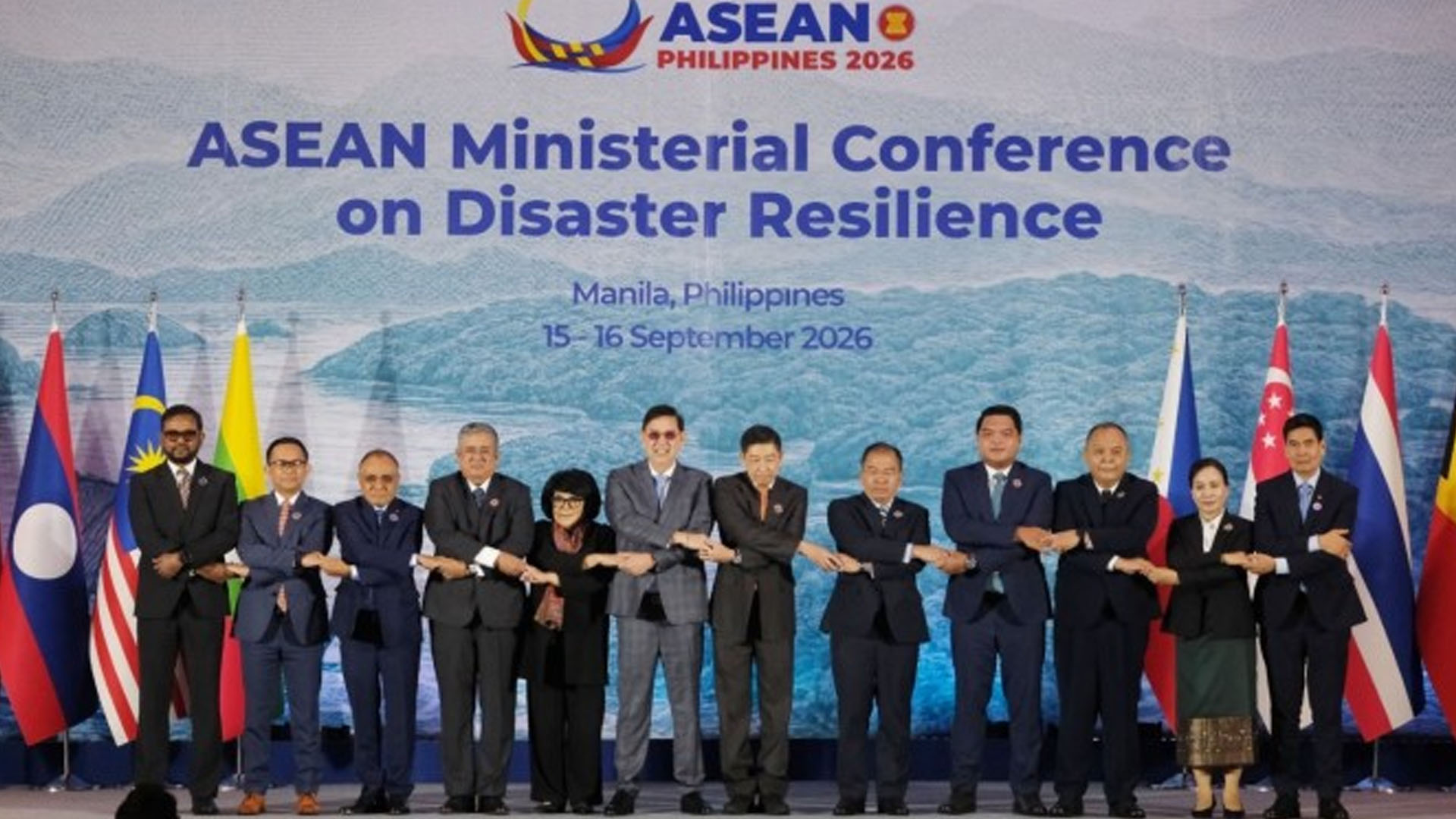







The Philippines has called on ASEAN member states to strengthen disaster preparedness, improve early warning systems and deepen regional cooperation as disasters become more frequent, interconnected and costly across Southeast Asia.
During the ASEAN Ministerial Conference on Disaster Resilience (AMCDR) on Tuesday, President Ferdinand R. Marcos, in his message read by Executive Secretary Ralph Recto, noted that disasters know no boundaries and urged ASEAN countries to coordinate responses across borders.
“As we gather for the ASEAN Ministerial Conference on Disaster Resilience, we are reminded that disasters do not respect borders. In a region as interconnected as ours, our response cannot also stop at our borders,” he said.
“This year marks 20 years of the ASEAN Agreement on Disaster Management and Emergency Response or AADMER. This occasion not only recognizes the cooperation among ASEAN Member States over the past decades in reducing imminent risks, strengthening preparedness, and responding to emergencies in the face of disasters. It also offers an opportunity to look ahead,” he added.
Marcos said ASEAN remains the world’s most disaster-prone region and pointed to gaps in knowledge, communication, hazard detection and monitoring capabilities among member states.
The Philippines, he said, continues to push for a stronger, more coordinated ASEAN disaster management system, including the proposed Manila-ASEAN Strategic Protocol for Emergency and Comprehensive Transformation, or Manila ASPECT, to improve disaster response and coordination.
The President also cited the Resilient, Innovative, Sustainable, and Empowered (RISE) ASEAN Agenda, which focuses on family resilience, support for young people and inclusive development for vulnerable communities.
Marcos outlined five priorities for ASEAN’s disaster resilience efforts, including strengthening the ability to anticipate risks and act before hazards strike, bringing regional commitments closer to communities, preparing for recovery ahead of disasters, using emerging technologies responsibly and treating resilience as a shared responsibility.
The Philippines, he said, has taken steps to improve its own capacity to act before disasters occur.
He noted that the signing of the Declaration of State of Imminent Disaster Act allows national and local governments to mobilize resources in anticipation of highly probable and imminent disasters, adding that building resilience requires addressing the long-term impacts of a changing climate.
In 2024, the Philippines submitted its first National Adaptation Plan, covering 2023 to 2050, to the United Nations Framework Convention on Climate Change, making the country the third ASEAN Member State and the 56th country in the world to submit such a plan.
Marcos said the beginning of the AADMER Work Program 2026–2030 gives the opportunity to put this principle into action.
“Our task is to ensure that our frameworks make a difference where they matter most—in our communities, our economies, and, above all, in the lives of our people,” he said.
“First, we must strengthen our ability to anticipate risk and act ahead of forecasted hazards. This means accelerating people-centered, end-to-end, multi-hazard early warning systems. It means improving risk knowledge and impact-based forecasting, while expanding anticipatory action,” he added.
Special Envoy of the President for Disaster Risk Reduction and Management Ma. Antonia Yulo-Loyzaga said the region’s security and prosperity increasingly depend on how countries adapt to complex, cascading risks and work together to address them.
“As you well know, the Asia-Pacific is the most disaster-prone region in the world, and the disasters that we face have grown in frequency, intensity, and complexity due in large part to a rapidly changing climate and the pace and trajectory of our development as a region,” she said.
Marcos noted that regional solutions must be rooted in local realities and that governments alone cannot build resilience.
“We are therefore grateful for the participation of our partners in civil society and the development sector as well,” she said, adding that ASEAN must work with the private sector, academe, scientific institutions and development partners.
United Nations Special Representative for Disaster Risk Reduction Kamal Kishore, in a recorded message, said ASEAN has demonstrated the value of regional cooperation in reducing disaster risks.
He cited AADMER as one of the world’s most advanced regional frameworks for disaster management and risk reduction and said ASEAN’s experience offers lessons to other regions facing increasingly complex disasters.
Kishore also called for prevention to remain central to disaster risk reduction and welcomed the ASEAN-UN Joint Strategic Plan of Action on Disaster Management 2026-2030.
He said the UN Office for Disaster Risk Reduction would continue supporting ASEAN efforts on risk governance, resilience financing, early warning systems and local risk communication, with attention to gender responsiveness and inclusion.
“These are practical measures that help countries move from managing disasters to managing risk, thereby saving lives and livelihoods,” Kishore said. (PNA)