


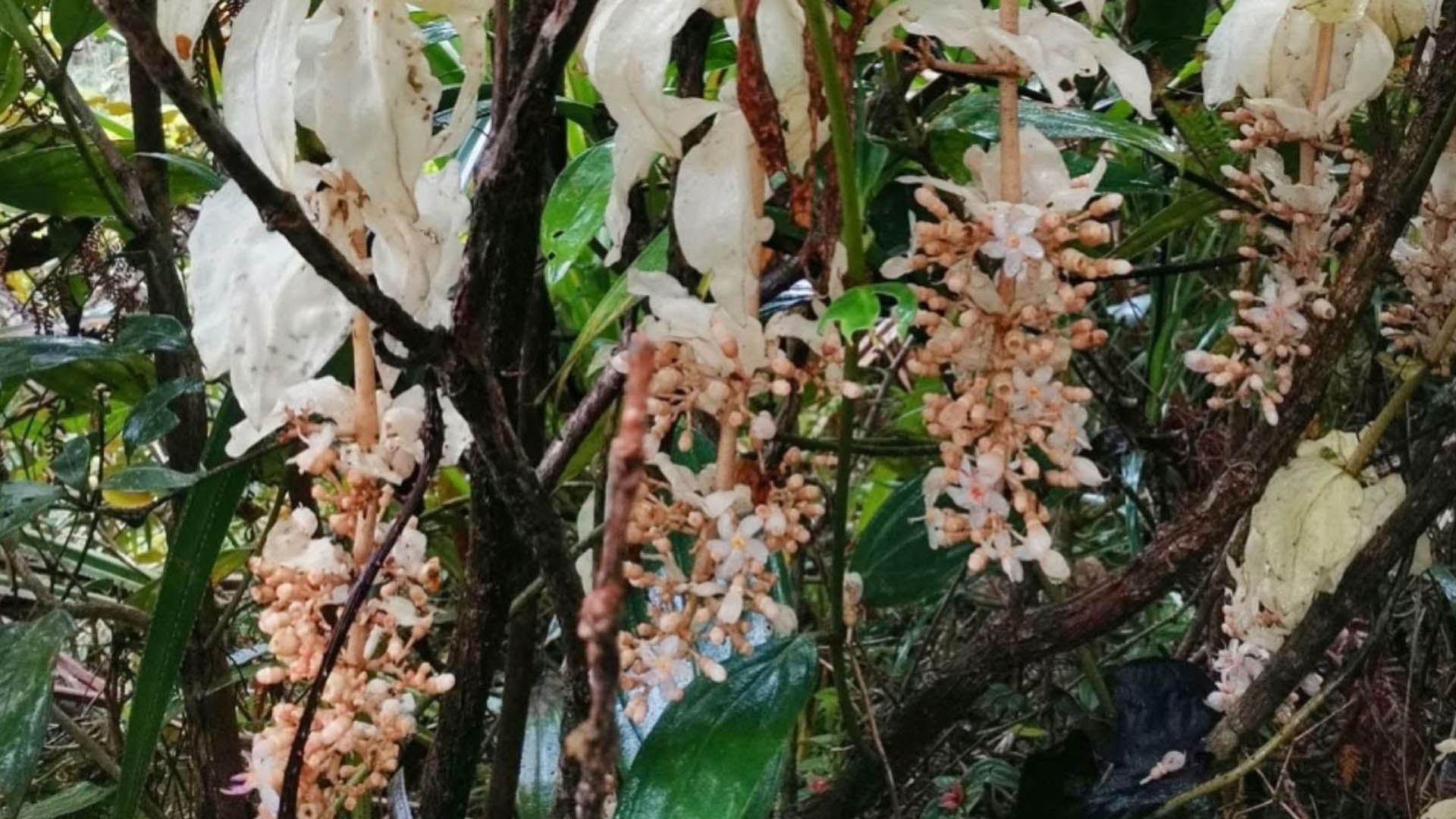







Researchers have documented another plant species previously unknown to science in Apayao, further highlighting the biodiversity of the province’s UNESCO Biosphere Reserve.
More than two years after UNESCO designated the Apayao Biosphere Reserve in July 2024, scientists continue to discover new plant species in its forests.
“We are glad we had it declared as a biosphere reserve, which can serve as a classroom for our scientists and a rich resource for researchers to discover previously undocumented plant and animal species,” Apayao Governor Elias Bulut Jr. said in a phone interview Tuesday.
Bulut said the latest discovery brings to three the number of plant species newly described from Calanasan, the municipality where the biosphere is located, since 2025.
The Apayao provincial government, in a social media post, said the newly described Medinilla bulutiorum was documented in Eva Puzon and formally published on Nov. 18, 2026, in the scientific journal Phytotaxa.
The study was authored by Jiro T. Adorador, Zhereeleen D. Meneses-Adorador, Breiden Dela Cruz, Sarah Mae C. Batil, Jayson C. Ibañez, and J. Peter Quakenbush.
The latest discovery follows the publication of Vaccinium kilangensis in October 2025, a blueberry relative collected from Kilang Pass in Barangay Butao, Calanasan, near the Apayao-Ilocos Norte boundary.
In February 2026, researchers also formally described Medinilla calanasan, which was first encountered in Barangay Eva.
“The succession of discoveries shows that Calanasan continues to provide valuable records for botanical research and adds to the scientific importance of the Apayao Biosphere Reserve,” the provincial government said.
Researchers noted that M. bulutiorum is common in its type locality but had remained unnoticed by botanists for more than a century.
The species resembles Medinilla magnifica but differs in its branchlets, smaller leaves, flower clusters, and the brown covering on parts of its inflorescence.
It was named in honor of the Bulut family, particularly the late Elias K. Bulut Sr., popularly known as “EKB” and regarded as the founding father of Apayao, in recognition of the family’s leadership and stewardship of ancestral lands.
Researchers have preliminarily assessed the species as data deficient, meaning available information on its distribution and population is insufficient to determine its extinction risk, the provincial government said.
Research support
Bulut said the provincial government has started training local residents to serve as guides for researchers exploring Apayao’s forests, considered the last frontier of the Cordillera Administrative Region (CAR).
“We need guides because the forest is thick and relatively untouched. It is important to ensure safety by having local guides assist researchers as they conduct their studies in our province,” he said.
Likewise, a library-museum in Calanasan has been established as a resource for researchers.
Bulut said the province is preparing communities to accommodate local and foreign scientists and researchers, including providing lodging facilities during their visits.
“We hope these activities, which have minimal to zero impact on the environment, will provide our people with additional livelihood opportunities in their own homes and communities. They can also prepare and serve home-cooked meals for researchers, giving them an additional source of income,” he said.
He said Apayao residents have long helped protect the province’s forests, but sustaining conservation efforts also requires ensuring that communities have viable sources of livelihood.
The challenge, he said, is to protect the environment while allowing residents to benefit from its conservation through sustainable livelihood opportunities. (PNA)