


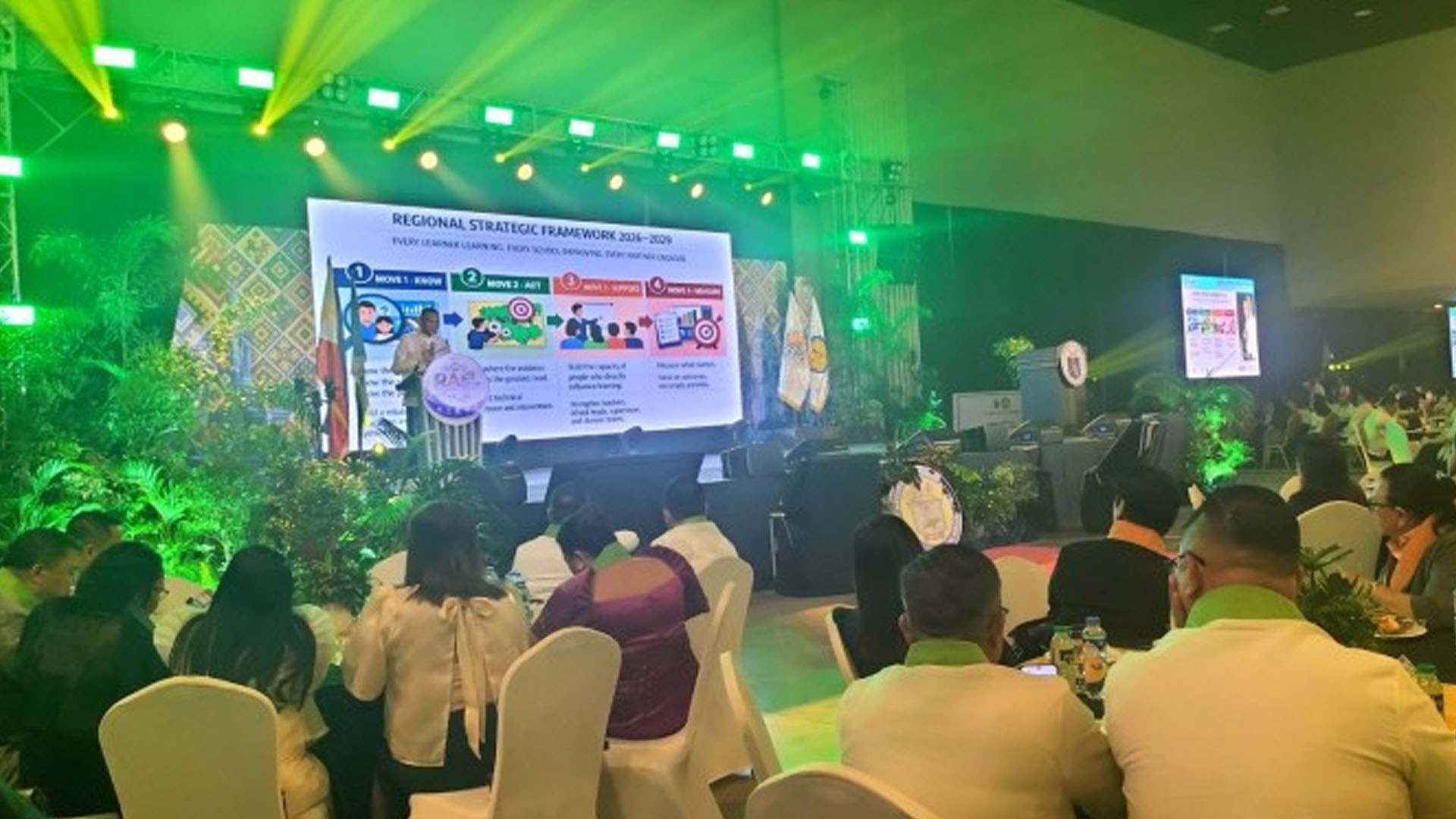







The Department of Education (DepEd) – Western Visayas has called on stakeholders to create a stronger education movement in the region.
This was the challenge raised by DepEd – Western Visayas Director Cristito Eco as he delivered his Regional Basic Education Report at the opening of the 1st Regional Assembly of Education Leaders (REAL) at the Iloilo Convention Center on Tuesday.
“A community cannot afford to say that education is somebody else’s responsibility. The urgency is now, the opportunity is now, and the responsibility belongs to all of us. For the next three years, DepEd – Western Visayas will pursue a clear direction: every learner included, every teacher empowered, every school improving, every stakeholder engaged,” Eco said.
He urged for an education system where excellence is not reserved for a few, where opportunity is not determined by geography or circumstance and every child gains the knowledge skills and confidence for a better future.
Eco said the true measure of an education system does not rely on the numbers of programs implemented, reports submitted, or meetings conducted but by its learners.
DepEd data showed that the net enrollment rate in the past three school years for elementary and junior high school has been steadily declining, although senior high school is slightly increasing.
The transition rate generally dipped during School Year 2023-2024, while retention and promotion rates recovered in 2024-2025. The completion rate at the secondary level slightly recovered in 2024-2025. The cohort rate also recovered in 2024-2025 but remained below the 2022-2023 level. The secondary graduation rate was high after a partial recovery in 2024-2025, while elementary was generally stable despite a temporary drop in the previous school year.
A notable increase in repetition was observed in secondary education in 2024-2025. Further, the elementary school leaver rate was lower compared with the secondary education.
“Access is the first promise we must keep. The data tells us that there is an alarming concern in terms of access,” he said.
Meanwhile, functional literacy is also a regional challenge. He said that while a vast majority of learners possess basic literacy skills, a significant number continue to struggle with comprehension, critical thinking, and the practical application of knowledge.
“It compels us to strengthen foundational learning and improve educational outcomes at every level,” he said.
Eco also presented five critical challenges, requiring immediate attention and strategic intervention, including learning recovery and acceleration; teacher and school leader capacity; quality assurance and standards; equity, inclusion and learner well-being and governance, data and accountability.
He also lauded school division offices for the interventions they implemented to address some of the gaps.
“Let us make education our shared regional goal. Let us move from commitments to results, let us move from programs to impact, let us move from isolated efforts to collective education,” Eco urged. (PNA)